
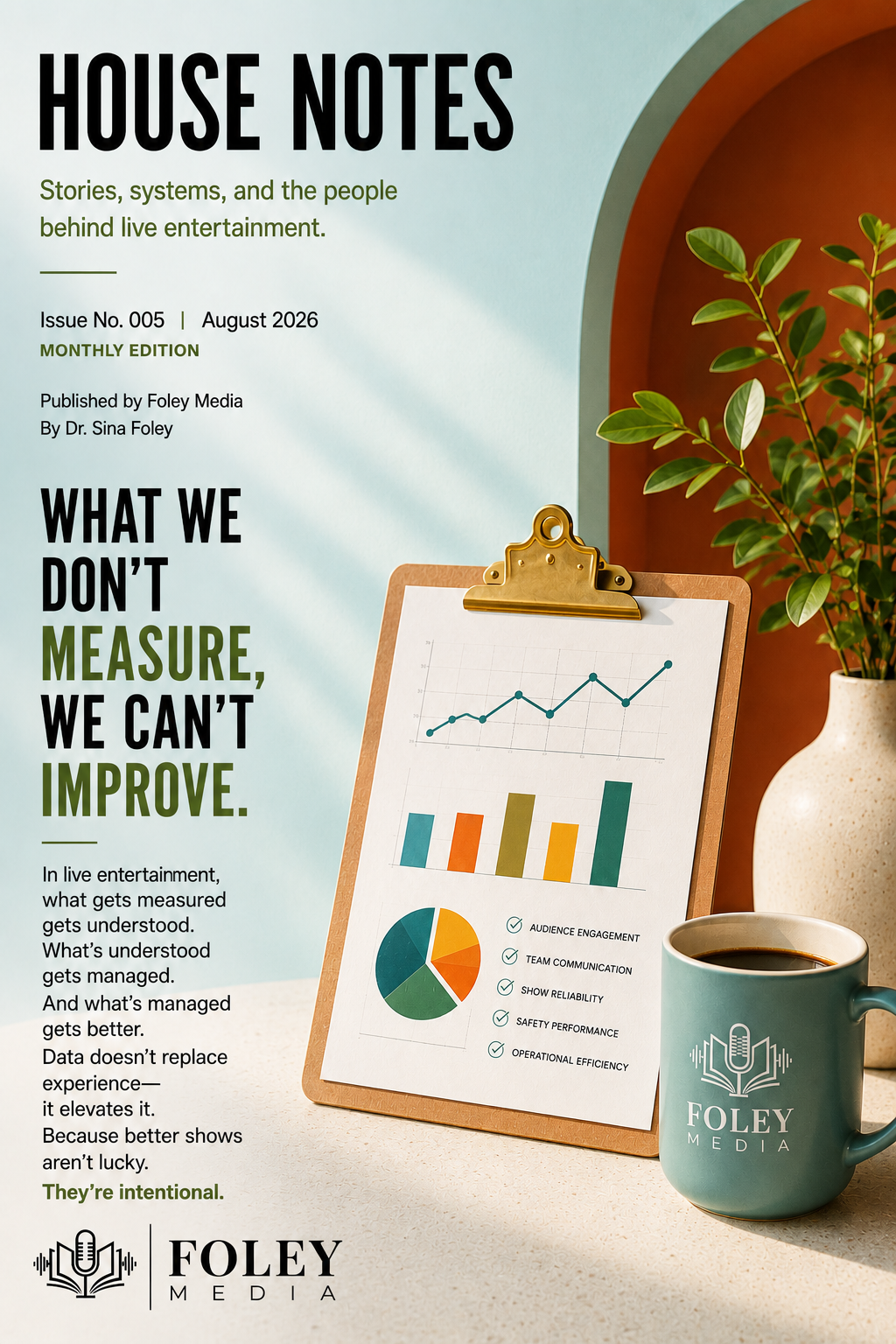
HOUSE NOTES
Stories, systems, and the people behind live entertainment.
Issue No. 005 | August 2026
Published by Foley Media
By Dr. Sina Foley
────────────────────────────
ABOUT HOUSE NOTES
House Notes is the monthly newsletter of Foley Media, exploring the systems, people, and culture behind live entertainment through observations, interviews, research, and practitioner perspectives.
────────────────────────────
EDITOR’S NOTE
Most decisions begin with a question.
Most improvements begin with information.
But information can only guide us when we can see it clearly.
This month, we’re exploring the relationship between visibility, measurement, and improvement—and why understanding a problem often begins with understanding how it is measured.
────────────────────────────
FROM THE DESK OF DR. SINA FOLEY
One of the more surprising lessons from my doctoral research was how difficult it can be to understand a workforce when the available data is grouped into broad categories.
At first glance, data appears objective. Numbers can create the impression that we are seeing a complete picture.
In reality, measurement is often a matter of perspective.
What is being counted? How is it being categorized? What information is visible, and what remains hidden?
These questions may sound technical, but they often shape how organizations understand the world around them.
These questions extend far beyond research.
Organizations measure guest satisfaction, employee engagement, operational performance, financial outcomes, training completion, and countless other indicators because they want to better understand how systems are functioning.
Measurement does not guarantee improvement.
But it often determines what receives attention.
This month, I want to explore the relationship between measurement, visibility, and decision-making—and why some of the most important questions begin with understanding what we can and cannot see.
— Dr. Sina Foley
FEATURE ARTICLE
WHAT WE DON’T MEASURE, WE CAN’T IMPROVE
Organizations rely on information to make decisions.
Whether managing a production, operating a venue, coordinating a workforce, or evaluating a policy, leaders depend on data to understand what is happening around them.
The assumption is simple: if we can measure something, we can better understand it. And if we understand it better, we can improve it.
But measurement is rarely as straightforward as it appears.
Data is not simply collected. It is categorized, grouped, defined, and interpreted. The way information is organized can significantly influence what becomes visible and what remains hidden.
Imagine a workforce grouped into a broad occupational category. The data may provide useful information about the workforce as a whole, yet important differences between specific roles, environments, or experiences may be difficult to identify.
This challenge exists across many industries.
The issue is not always the absence of data. Sometimes the available data is simply too broad to answer more specific questions.
The distinction matters because visibility influences priorities, priorities influence decisions, and decisions ultimately influence outcomes.
Organizations cannot address every issue simultaneously. They often focus on what they can see.
This is why measurement matters.
Not because numbers tell the entire story.
But because they help reveal where additional questions may be needed.
Better visibility does not guarantee better outcomes.
It does, however, create the possibility for better decisions.
And in complex environments, that possibility matters.
────────────────────────────
FIELD NOTES
THE SPREADSHEET
Somewhere behind nearly every major decision is a spreadsheet.
Schedules, budgets, staffing plans, survey results, operational reports, and forecasts may appear routine, yet they often shape how organizations allocate resources, identify priorities, and evaluate performance.
Most people never see these documents, but the information they contain often influences how organizations allocate resources, identify priorities, and evaluate performance.
Behind many successful operations are countless hours spent organizing information, identifying patterns, and trying to better understand what is happening beneath the surface.
The spreadsheet may never receive applause.
Yet it often helps shape the performance.
────────────────────────────
VOICES FROM THE INDUSTRY
“Verify it.”
A recurring theme throughout my conversation with John Katsilometes was the importance of verification.
Before conclusions come facts.
Before facts come evidence.
Journalism depends on gathering evidence, confirming details, and developing a clearer understanding of what occurred.
In many ways, organizations face a similar challenge.
Good decisions require good information.
The quality of our conclusions often depends on the quality of the information available to us.
Understanding begins with asking better questions—and verifying what we think we know.
────────────────────────────
ON OUR RADAR
Emerging Themes in Entertainment Operations
• Workforce analytics and visibility
• Data-informed decision-making
• Near-miss reporting systems
• Audience behavior trends
• Employee retention and engagement
• Measuring training effectiveness
────────────────────────────
PODCAST SPOTLIGHT
THE HEADLINER & THE HOUSE
Stories, systems, and the people behind live entertainment.
Future conversations will explore how industry professionals gather information, make decisions, solve problems, and navigate complex operational environments.
Because every decision begins with understanding what is happening beneath the surface.
────────────────────────────
COMMUNITY QUESTION
What metric do you think organizations rely on too heavily—and what important information might it miss?
────────────────────────────
COMING UP
Issue No. 006 – Voices From the Field
Insights and observations from professionals working behind the scenes across entertainment, events, and hospitality environments.
FINAL CUE
The most important numbers are not always the biggest ones.
Sometimes the most valuable information comes from asking better questions.
Measurement is not simply about counting; it is about understanding.
And understanding is often where improvement begins.
Until next time,
Dr. Sina Foley
Publisher, House Notes
Published by Foley Media
© 2026 Foley Media. All Rights Reserved.