
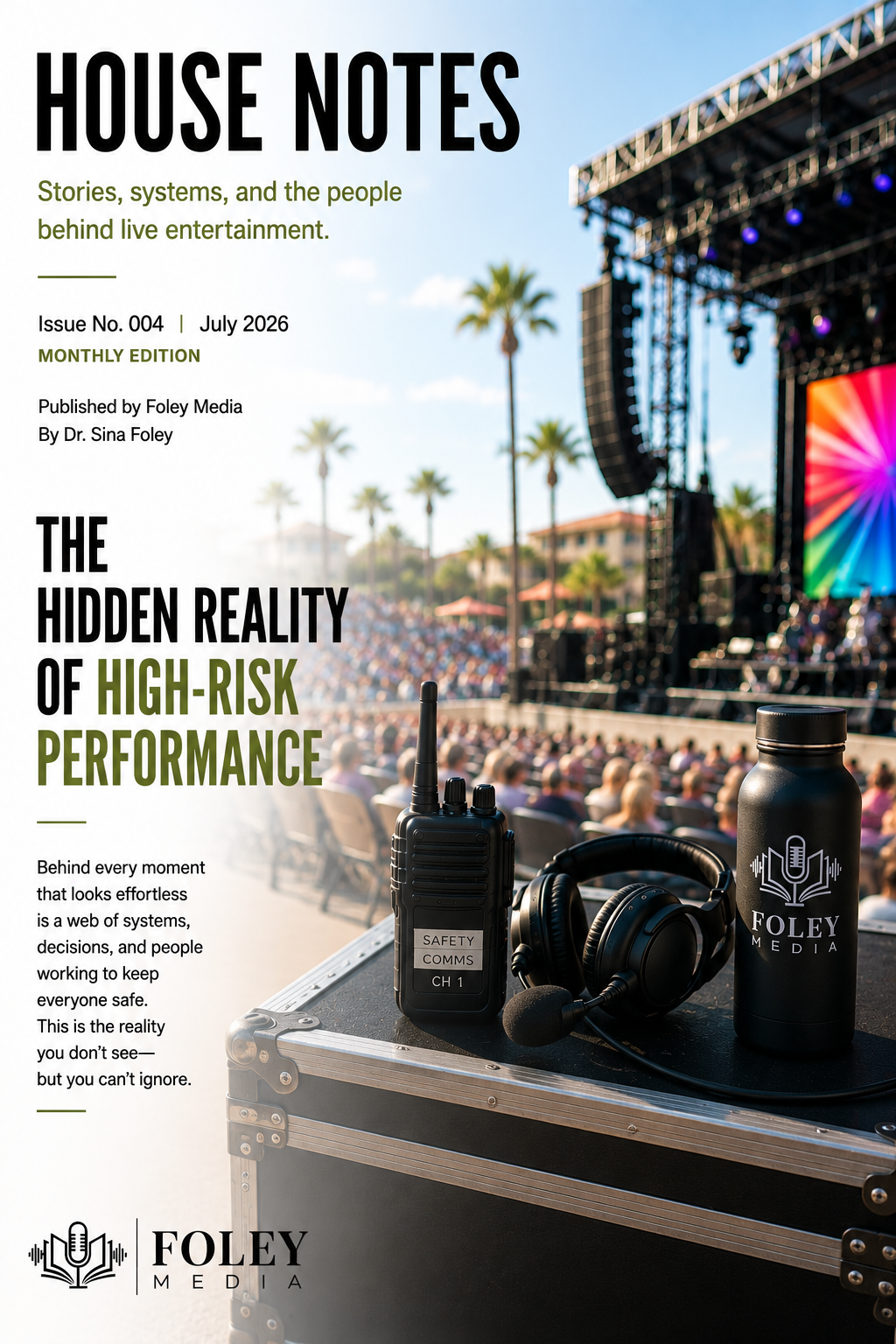
HOUSE NOTES
Stories, systems, and the people behind live entertainment.
Issue No. 004 | July 2026
Published by Foley Media
By Dr. Sina Foley
────────────────────────────
ABOUT HOUSE NOTES
House Notes is the monthly newsletter of Foley Media, exploring the systems, people, and culture behind live entertainment through observations, interviews, research, and practitioner perspectives.
────────────────────────────
EDITOR’S NOTE
Risk is a word that often carries negative connotations.
When audiences hear it, they may think about danger, accidents, or uncertainty.
In professional entertainment environments, however, risk is often viewed through a different lens.
Risk exists whenever people create something ambitious.
The question is rarely whether risk exists. The question is how it is understood, communicated, and managed.
This issue explores the often-invisible preparation that supports high-performance environments and the people responsible for helping complex productions operate safely and successfully.
────────────────────────────
FROM THE DESK OF DR. SINA FOLEY
One of the things that has always fascinated me about live entertainment is the contrast between what audiences experience and what professionals see.
Audiences experience the outcome, while professionals often focus on the preparation that makes that outcome possible.
A breathtaking aerial act, a complex automation sequence, a performer flying above an audience, or a perfectly timed cue can appear effortless to spectators.
To the people responsible for delivering those moments, however, they represent planning, training, communication, and preparation.
The most successful productions often make complexity look simple.
That simplicity is usually the result of extraordinary effort behind the scenes.
This month, I want to explore the relationship between performance and preparation—and why some of the most important work in entertainment happens long before the audience arrives.
— Dr. Sina Foley
────────────────────────────
FEATURE ARTICLE:
THE HIDDEN REALITY OF HIGH-RISK PERFORMANCE
Live entertainment is built on extraordinary moments. Artists fly, acrobats tumble, pyrotechnics ignite, and automation systems move scenery with remarkable precision. Performers execute physically demanding choreography under changing conditions and tight timelines.
Audiences often experience these moments as magic.
Behind the scenes, professionals experience them as the product of interconnected systems. Training, communication, operations, maintenance, emergency planning, and organizational culture all contribute to the successful execution of a performance.
The public conversation surrounding risk often focuses on incidents. The professional conversation focuses on preparation.
What happens before the performance? How are performers trained? How are hazards identified? How are responsibilities assigned? How are contingencies discussed? How are teams prepared to respond when something unexpected occurs?
These questions rarely generate headlines. Yet they are often where the most important work takes place.
The goal of a professional entertainment environment is not to eliminate all risk. In many cases, that would be impossible.
Instead, the goal is to understand risk, communicate about it, prepare for it, and manage it responsibly.
An audience may witness a single breathtaking moment.
Behind that moment may be hundreds of hours of planning.
The better the preparation, the more invisible it becomes.
The safest systems are often the ones audiences never notice.
────────────────────────────
FIELD NOTES
THE REHEARSAL NOBODY SEES
Every performance has a rehearsal—sometimes many rehearsals.
But some of the most important rehearsals have nothing to do with the performance itself. Emergency procedures are reviewed, communication protocols are tested, equipment is inspected, contingencies are discussed, and teams confirm their readiness long before an audience arrives.
Many audience members will never know these conversations took place. And that is often the point.
────────────────────────────
VOICES FROM THE INDUSTRY
“Nobody does it better.”
A recurring theme throughout my conversation with John Katsilometes was the respect many professionals have for organizations that consistently operate at a high level.
When discussing large-scale productions, he noted that few entertainment companies have pushed creative and technical boundaries more successfully than Cirque du Soleil.
The observation serves as an important reminder.
Excellence is not a destination; it is a process.
The most respected organizations are often those that continue evaluating, refining, and improving their systems long after they have achieved success.
Continuous improvement is not a sign that something is wrong; it is often a sign that an organization takes its responsibilities seriously.
────────────────────────────
ON OUR RADAR
Emerging Themes in Entertainment Operations
• Human performance and fatigue management
• Training consistency across large workforces
• Communication in high-tempo environments
• Temporary structures and event infrastructure
• Near-miss reporting and organizational learning
• Technology integration within live productions
────────────────────────────
PODCAST SPOTLIGHT
THE HEADLINER & THE HOUSE
Stories, systems, and the people behind live entertainment.
Many conversations about entertainment focus on what audiences can see.
The Headliner & The House explores what happens behind the scenes.
From performers and producers to journalists, technicians, and industry leaders, future episodes will examine the systems, decisions, and human experiences that shape live entertainment.
────────────────────────────
COMMUNITY QUESTION
What aspect of production preparation do you think audiences would find most surprising?
────────────────────────────
COMING UP
Issue No. 005 – What We Don’t Measure We Can’t Improve
Exploring data visibility, injury reporting, workforce metrics, and why measurement matters.
Issue No. 006 – Voices From the Field
Insights gathered from conversations with professionals working behind the scenes across the entertainment and events industries.
────────────────────────────
FINAL CUE
The safest productions are often the ones audiences never think about.
Not because risk doesn’t exist.
But because preparation has become invisible.
When planning, communication, training, and execution align, the audience experiences something extraordinary.
A moment. A memory. A performance.
What they don't see is the preparation that made it possible.
Until next time,
Dr. Sina Foley
Publisher, House Notes
Published by Foley Media
© 2026 Foley Media. All Rights Reserved.