
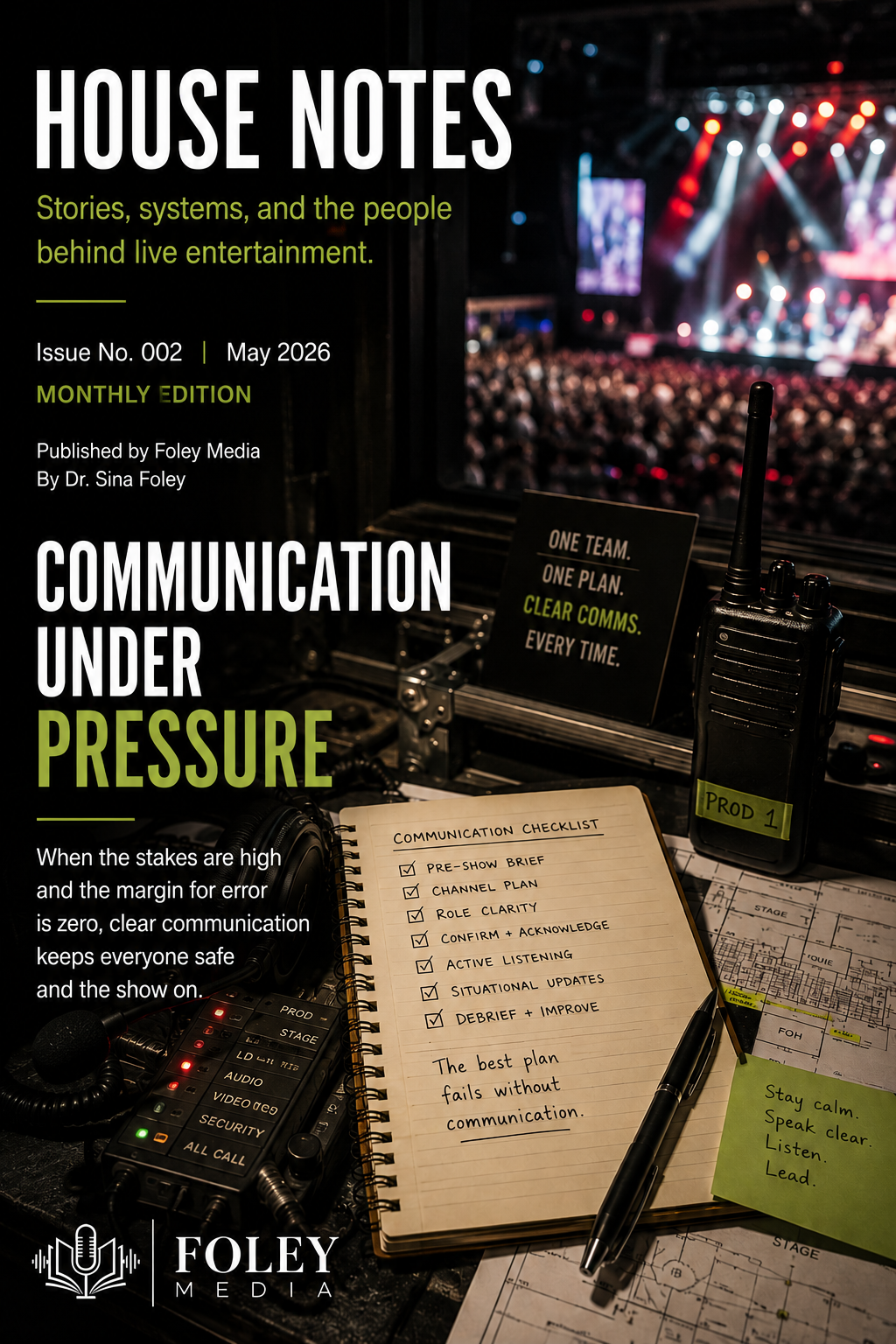
HOUSE NOTES
Stories, systems, and the people behind live entertainment.
Issue No. 002 | May 2026
Published by Foley Media
By Dr. Sina Foley
ABOUT HOUSE NOTES
House Notes is a monthly publication of Foley Media, exploring the systems, people, and culture behind live entertainment through observations, interviews, research, and practitioner perspectives.
────────────────────────────
EDITOR'S NOTE
Communication is often treated as a personal skill—something that helps individuals build relationships, convey ideas, or avoid misunderstandings. In complex environments, however, communication serves a broader purpose. It functions as infrastructure, helping people coordinate, adapt, and make decisions under changing conditions.
This issue explores the role communication plays in high-pressure environments and why the movement of information can be just as important as the movement of people, equipment, and resources.
────────────────────────────
FROM THE DESK OF DR. SINA FOLEY
My academic background began in communication studies, but it wasn't until I worked in production, hospitality, entertainment operations, and research that I fully appreciated its practical value.
In those environments, I came to understand that communication is not simply what we say; it is how organizations coordinate action.
────────────────────────────
FEATURE ARTICLE:
COMMUNICATION UNDER PRESSURE
"Stand by."
In live entertainment, those two words carry remarkable weight.
They may be spoken moments before a performer steps onto a stage, a lighting cue is executed, a scene change begins, or a venue opens its doors to thousands of guests. To an outsider, the phrase may seem routine. To the people responsible for delivering the experience, it signals readiness, coordination, and shared awareness.
The phrase also serves as a reminder that communication is far more than the exchange of information. It is the mechanism through which complex environments function.
When most people think about infrastructure, they think about physical things—buildings, roads, equipment, or technology. Yet every successful production depends upon another form of infrastructure that is largely invisible: information.
Production meetings, cue sheets, safety briefings, headset calls, shift notes, radio traffic, and post-show reviews all help transform information into coordinated action. These systems connect departments that may spend much of the day operating independently but must ultimately function as a single organization.
In live entertainment, communication is rarely confined to one team. A schedule change may affect performers, technicians, security personnel, front-of-house staff, and venue operations simultaneously. A technical issue may require coordination across multiple departments within minutes. A weather concern can alter logistics, staffing, timelines, and contingency planning all at once.
Information rarely remains confined to a single department. As it moves, people adjust, resources shift, and decisions are made.
When communication breaks down, the effects often extend well beyond a simple misunderstanding. A missed message can become a delayed cue. A delayed cue can create operational disruption. In some circumstances, those disruptions may introduce entirely new challenges for workers, performers, guests, and organizations.
For that reason, communication is often underestimated as an operational function. In practice, it is one of the most important operational functions within any complex system.
The strongest organizations recognize this reality. They invest in communication processes, establish common language, create reliable feedback loops, and prioritize clarity across departments. They understand that information is not merely something people possess—it is something organizations depend upon.
Most audience members will never hear the words spoken over a production headset. Nor should they.
When communication systems function effectively, they become nearly invisible. The audience experiences a performance. The workforce coordinates to make that performance possible.
Sometimes that coordination begins with two simple words:
"Stand by."
────────────────────────────
FIELD NOTES:
COPY THAT
One of the shortest phrases used in production environments is also one of the most important.
"Copy that."
The words rarely attract attention. They don't make a major decision or signal the beginning of a performance. Instead, they serve a simpler purpose: confirming that information has been received and understood.
In fast-moving environments, a message delivered is not necessarily a message understood. A message is valuable only when others can understand it and act upon it.
Sometimes the difference between assumption and confirmation is only two words.
"Copy that."
────────────────────────────
VOICES FROM THE INDUSTRY
One observation heard repeatedly across entertainment environments is that departments may be organized separately, but they rarely operate independently.
A production challenge in one area often affects several others. The same is true of success. Strong communication allows information, resources, and expertise to move across organizational boundaries when they are needed most.
The most effective teams understand that communication is not simply about sharing information. It is about maintaining alignment across a system in which many people are working toward the same outcome.
────────────────────────────
ON OUR RADAR
• Cross-department communication
• Information flow during live events
• Workforce coordination
• Leadership communication
• Near-miss reporting systems
• Organizational learning
────────────────────────────
PODCAST SPOTLIGHT
The Headliner & The House explores the people, systems, and experiences behind live entertainment. Future conversations will examine decision-making, leadership, communication, and the human experience behind the work. Many of the themes explored in House Notes begin as conversations.
────────────────────────────
COMMUNITY QUESTION
What communication practice has had the greatest positive impact on your team or organization?
────────────────────────────
COMING UP
Issue No. 003 — Paying Attention: How Important Stories Begin
Issue No. 004 — The Hidden Reality of High-Risk Performance
────────────────────────────
FINAL CUE
Communication is often most visible when it breaks down. Yet its greatest value is revealed when everything works as intended. Information moves. People coordinate. Decisions become action. What appears effortless to an audience is often the result of countless conversations, confirmations, and adjustments happening behind the scenes.
Until next time,
Dr. Sina Foley
Publisher, House Notes
────────────────────────────
Published by Foley Media
© 2026 Foley Media. All Rights Reserved.