
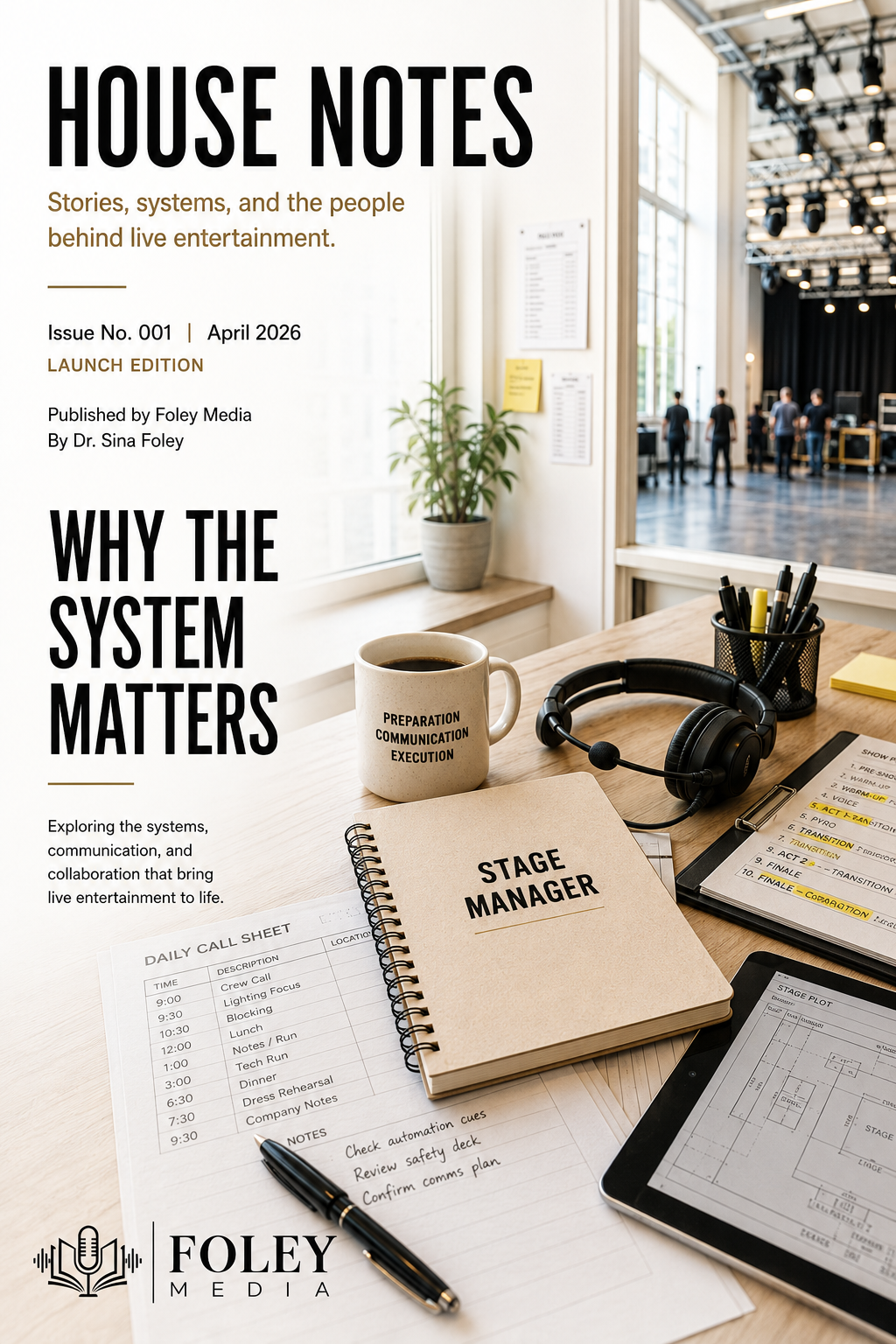
HOUSE NOTES
Stories, systems, and the people behind live entertainment.
Issue No. 001 | April 2026
LAUNCH EDITION
Published by Foley Media
By Dr. Sina Foley
ABOUT HOUSE NOTES
House Notes is a publication of Foley Media exploring the systems, people, and culture behind live entertainment through observations, interviews, research, and practitioner perspectives.
────────────────────────────
EDITOR'S NOTE
For most audiences, live entertainment begins when the lights go down. Yet every performance begins long before that moment. Behind every concert, sporting event, convention, residency, festival, and production exists a network of people, decisions, systems, and processes working together toward a shared outcome. This inaugural edition explores why those systems matter—and why understanding them offers a different perspective on the entertainment experiences we often take for granted.
────────────────────────────
FROM THE DESK OF DR. SINA FOLEY
For much of my life, I have experienced live entertainment from multiple vantage points: performer, producer, manager, educator, researcher, and observer.
The longer I worked in entertainment, the more I realized that some of the most fascinating stories exist beyond the spotlight. House Notes grew from that curiosity, but also from a larger observation: live entertainment offers a unique window into how complex systems function.
Every performance depends on communication, coordination, leadership, planning, decision-making, and trust. In that sense, entertainment is not entirely different from healthcare, aviation, education, hospitality, or government. It simply makes those dynamics easier to see because the outcome is public, immediate, and highly visible.
For me, that is what makes this industry so interesting.
Entertainment creates experiences, but it also reveals how people work together, how organizations adapt, and how culture develops. House Notes exists to explore those ideas through the lens of live entertainment and the people who help bring it to life.
────────────────────────────
FEATURE ARTICLE: WHY THE SYSTEM MATTERS
For most audiences, live entertainment begins with a moment. The house lights dim, the curtain rises, a performer steps onto a stage, and a story begins to unfold. What follows may last ninety minutes, two hours, or an entire evening. Yet the experience itself represents only the visible portion of something much larger.
Long before an audience arrives, a different process is already underway. Schedules have been created, equipment has been tested, rehearsals have taken place, staffing plans have been finalized, communications have been distributed, and contingencies have been discussed. Countless decisions—many of them seemingly small—have already begun shaping the experience guests will ultimately see.
Most audiences never think about these activities, nor should they. People attend concerts, productions, sporting events, and festivals to enjoy the experience itself, not to analyze the infrastructure supporting it. Yet that infrastructure matters.
Every performance, regardless of size, exists within a system. People, technology, processes, resources, and decisions must work together to produce a shared outcome. The larger and more complex the environment becomes, the more dependent it becomes on coordination.
Las Vegas offers a particularly interesting example. Within a relatively small geographic area, the city hosts major sporting events, residency productions, conventions, festivals, hospitality operations, and some of the most technically sophisticated entertainment environments in the world. What audiences experience as a single moment is often the result of months—or even years—of planning, preparation, and collaboration.
In many ways, entertainment provides a useful lens for understanding complex systems more broadly. Hospitals, airports, universities, and governments all depend upon coordination among people, processes, and resources. Entertainment simply makes those systems easier to observe because the outcome is public, immediate, and highly visible.
When systems fail, people notice. A delayed flight draws attention to the airport. A disrupted performance draws attention to the production. A communication breakdown draws attention to the organization itself.
Success, by contrast, often appears effortless.
That may be why systems are so frequently overlooked. Their greatest achievement is making complexity appear simple.
The audience remembers the performance.
The workforce remembers everything required to make it happen.
House Notes was created to explore the space between those two perspectives.
────────────────────────────
FIELD NOTES: THE MOMENT BEFORE
There is a moment before nearly every live event when the atmosphere begins to change.
It is rarely dramatic. Most audience members never notice it.
Backstage, however, the signals are unmistakable. Final checks are completed. Conversations become more focused. Headsets become more active. People who may have spent the day working independently begin to converge on a shared objective.
The shift is subtle, but it reflects something important about live entertainment. Performances are often remembered as singular moments, yet they are made possible by dozens—or sometimes hundreds—of people aligning their efforts at precisely the right time.
For a brief period, preparation gives way to execution, and then the show begins.
────────────────────────────
VOICES FROM THE INDUSTRY
One observation has surfaced repeatedly throughout my career, regardless of role, venue, or discipline: successful outcomes are rarely individual achievements.
Performers depend on technicians. Technicians depend on operators. Operators depend on planners. Planners depend on information. Information depends on communication.
The public often encounters the finished product and naturally associates success with the most visible individual or moment. Those working behind the scenes tend to understand something different: exceptional outcomes are usually collective achievements.
The larger and more complex the environment becomes, the more dependent it becomes on coordination.
Talent, experience, and leadership all matter. Yet none of them operate in isolation. The most successful productions are often those in which people understand not only their own responsibilities, but how their work connects to everyone else's.
The most successful productions are often those in which people understand not only their own responsibilities, but how their work connects to everyone else's.
────────────────────────────
ON OUR RADAR
• Systems thinking in entertainment
• Workforce sustainability
• Communication and coordination
• Production complexity
• Safety culture
• Entertainment labor trends
────────────────────────────
PODCAST SPOTLIGHT
The Headliner & The House explores the stories, systems, and people behind live entertainment. Future conversations will explore the people, decisions, systems, and experiences that shape live entertainment both onstage and behind the scenes.
────────────────────────────
COMMUNITY QUESTION
What part of live entertainment do you think audiences rarely consider—but couldn't happen without?
────────────────────────────
COMING UP
Issue No. 002 — Communication Under Pressure
Issue No. 003 — Paying Attention: How Important Stories Begin
────────────────────────────
FINAL CUE
Complexity is often most visible when something goes wrong.
Yet some of the most remarkable achievements in live entertainment happen when everything works exactly as intended.
House Notes exists to explore the people, systems, and decisions that make those moments possible.
Until next time,
Dr. Sina Foley
Publisher, House Notes
────────────────────────────
Published by Foley Media
© 2026 Foley Media. All Rights Reserved.