
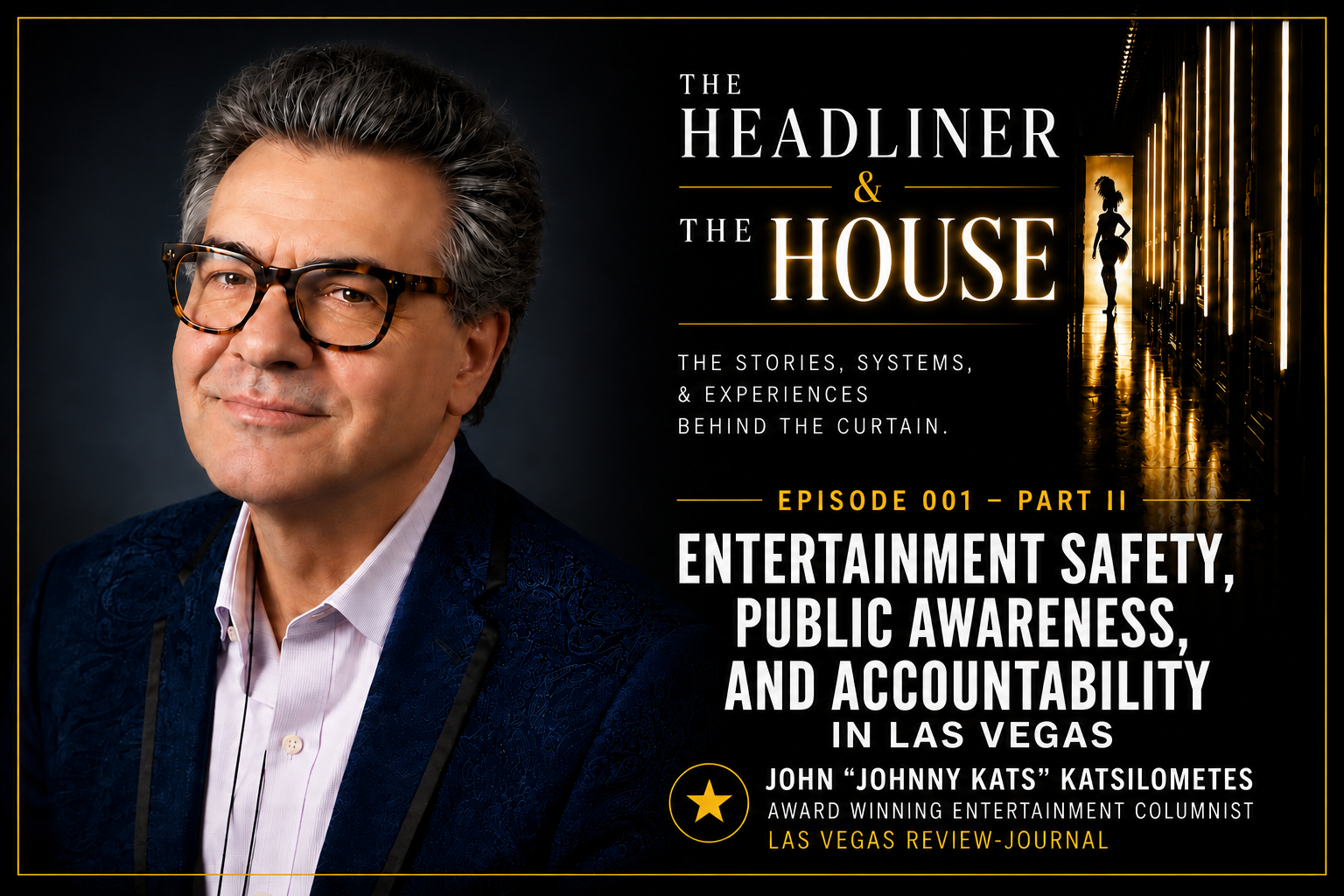
Entertainment Safety, Public Awareness, and Accountability in Las Vegas
Guest: John "Johnny Kats" Katsilometes · Award-Winning Entertainment Columnist, Las Vegas Review-Journal
In Part Two of his conversation with award-winning entertainment columnist Johnny Katsilometes, Dr. Sina Foley explores the intersection of entertainment, safety, public awareness, and accountability in one of the world's most production-intensive cities.
Drawing on decades of experience covering Las Vegas entertainment, Johnny reflects on high-profile incidents, the realities of risk in performance environments, the role of OSHA investigations, and the challenges of reporting on issues that often unfold behind the scenes. The discussion examines how journalists, producers, regulators, and performers each contribute to a culture of safety and transparency.
The conversation also explores broader questions of labor, oversight, and public understanding, offering a rare look at how information moves from incident to investigation to public awareness.
Part reflection, part industry discussion, this episode examines the responsibilities that accompany live entertainment—and the people, institutions, and communities that help shape Las Vegas as one of the world's most unique entertainment capitals.
Audio coming soon.
Award-winning journalist, columnist, and one of the most recognizable voices in Las Vegas entertainment, Johnny Katsilometes has spent decades chronicling the people, productions, and moments that define the city's cultural landscape.
Known to readers simply as "Johnny Kats," he is the longtime entertainment columnist for the Las Vegas Review-Journal and creator of the widely followed Kats! column, where he covers everything from major residencies and headline performers to emerging productions, industry developments, and the personalities shaping the entertainment capital of the world.
Throughout his career, Katsilometes has earned numerous honors, including Nevada Press Association Journalist of the Year and multiple Best of the West awards for column writing. In 2019, he was inducted into the UNLV College of Fine Arts Hall of Fame in recognition of his contributions to arts and entertainment journalism.
Respected for his deep industry relationships, relentless curiosity, and on-the-ground reporting style, Johnny has become a trusted storyteller and historian of modern Las Vegas entertainment. Whether covering a major production announcement, documenting a pivotal moment in the city's entertainment history, or exploring the human stories behind the spotlight, he brings a unique blend of insight, credibility, and perspective to every story.
"When things go wrong, they need to be held accountable."
"It's not a foolproof process."
"It's not a recitation of negative coverage. It's to let people know we're paying attention."
"You have to have so much more than talent to do it in Las Vegas."
One of the most interesting aspects of this conversation was recognizing how many people share responsibility for the safety and well-being of those who work in live entertainment.
Performers, technicians, producers, venue operators, regulators, and journalists all view incidents through different lenses, yet each contributes to our understanding of risk, accountability, and prevention. Johnny's perspective offered a valuable reminder that public awareness often begins with information—how it is gathered, verified, contextualized, and ultimately shared with a community.
As someone who has spent much of my career both onstage and behind the scenes, I was particularly struck by the human dimension behind these discussions. Conversations about safety are ultimately conversations about people: their livelihoods, their health, their families, and their ability to continue doing the work they love.
Las Vegas remains one of the world's most remarkable entertainment ecosystems. Preserving that legacy requires not only talent and innovation but also a commitment to learning from challenges, asking difficult questions, and continuously improving the systems that support the industry.
— Dr. Sina Foley
- Entertainment Safety
- Public Awareness
- Media Accountability
- OSHA & Incident Reporting
- Risk in Live Performance
- Emergency Response
- Entertainment Labor Issues
- Unionization & Workforce Relations
- Journalism & Public Understanding
- Entertainment Labor & Workforce Culture
- The Las Vegas Entertainment Community
- Authenticity & Local Arts Culture
Full Transcript
THE HEADLINER & THE HOUSE
Episode 001 – Part II
Entertainment Safety, Public Awareness, and Accountability
Featuring: John "Johnny Kats" Katsilometes
Award-Winning Entertainment Columnist | Las Vegas Review-Journal
Published: July 2026
INTRO:
[Male VO] In every great show, there’s the moment everyone sees.
[Female VO] The spotlight, the applause, the performance!
[Male VO] But beyond the lights, beyond the curtain, there’s another world unfolding…
[Female VO] The stories, the sacrifices, the secrets behind the stage.
[Male VO] From the people in the wings…
[Female VO] To the machinery behind the spectacle.
[Male VO] This is where the realities behind live entertainment reveal themselves.
[Both VO] This is The Headliner & The House.
[Sina] (Pre-recorded)
Welcome back to The Headliner & The House. I'm Dr. Sina Foley.
In Part One of my conversation with award-winning entertainment columnist Johnny Katsilometes, we explored journalism, storytelling, and life in the field covering Las Vegas entertainment.
In this segment, we shift our focus to entertainment safety, public awareness, and accountability.
Here's Part Two of our conversation.
[Sina]
I'm looking at entertainment safety regulation in particular - the OSHA 30-hour training and the 10-hour training for general safety entertainment workers, and I know that you've done quite a few pieces around town that cover - let's say - high profile events like, you know, Cirque accidents, etc. So, if you don't mind, I kind of wanted to talk a little bit about that. I, I remember reading in my first semester, you know just beginning to go through some of your work, the article on Mitrione. I'm not sure if I'm saying that right. I'm sorry – who…
[Johnny]
Yeah, the diver.
[Sina]
Who was injured in the…the diver, yeah.
[Johnny]
Kyle, and – I think it is Mitrione.
[Sina]
Kyle, yeah, is it Mitrione?
and I just – what, what impacted me so much after you went through telling us about the severity of his injury. I think he became a quadriplegic, right?
Yeah, after a mishap during a diving act at the “O” show at the Bellagio. And It was so impactful to read all your stats, you know, and to see how his quality of life was forever changed ..
[Johnny]
Yes!
[Sina]
And, and, and his family's. And, and the OSHA fine was, I think, two $15,000 slaps on the wrist, which were later, I think, excused - I believe excused or so. So, all these things… and as a professional entertainer with a long-term career here in Las Vegas, too, that really struck me. And it actually set me on my path to, to kind of look into some of these safety issues - is because, like, how is it that in a town like this, where we have such qualified talent, such amazing production value, and, and resource behind us… How, how are people still getting injured in rehearsals - in live performances and things? So, do you have any off-the-top impressions of what it means to be a high-risk performer here in in Las Vegas?
[Johnny]
Well, if you bring up Cirque de Soleil, for example, there are a lot of Cirque-like performers in Las Vegas or in Spiegelworld, and the “V – The Ultimate Variety Show” has had you know, they have danger-acts.
[Sina]
Yeah - we love ‘em!
[Johnny]
Some are called - there was one called “Danger Games,” in case you, you know - this Alan Silva - crossbow act - called that. And it's a - I'll tell you that to me, it's a reminder of what the risk factor is in an accepted way in that culture, first. Cirque de Soleil has an accepted amount of risk in their shows. that's what makes them what they are. When you - when you throw “death defying” into a description of a show… They had a thing called “The Wheel of Death.”
[Sina]
Yes.
[Johnny]
You know? I don't know if they're still calling it that, but that's in “Mad Apple” right now.
[Sina]
Yeah- yeah, it's amazing!
[Johnny]
Yeah, when you throw death into the equation, that means that it death is in play, in fact. It's not just a throwaway title. This is what's compelling about what these people do… People do. They're people! And I go back to maybe - I guess, I guess the best early example of this is when the, the woman was killed in “Kà”
[Sina
Yes.
[Johnny]
“Sarah Guillot-Guyard” in the final battle scene –
[Sina]
The vertical wall, yes…
[Johnny]
The wall goes up – the, the thin wire that was in her harness got trapped in the pulley that had a sharp edge on it. It sliced it, and she fell to her death 75 feet. First of all, you don't really realize, especially as it pertains to Cirque because it's such a precision company that knows that those people are actually humans until something goes wrong. It's not when things are running perfectly - it's just a beautiful experience. But when things go wrong, and I've seen him go wrong in a very low, you know a lot less impactful way than that. You know, people missing their mark, you know. People falling in one way or another. Acts breaking – balancing acts breaking once in a while. I had a pole come off the “Absinthe” low wire act - in the media previews! If you, if you were around for that - that was in one of the person who was in media got hit in the head with a pole.
[Sina]
Oh my goodness.
[Johnny]
It slipped off. These things happen.
[Sina]
Yes.
[Johnny]
When you're running a show like “O,” you know multiple… Every night, multiple times a night per week - I think they were doing at least 10 - probably up to 14 shows a week. And
[Sina]
Oh wow, yes.
[Johnny]
And you're doing all this stuff… all – the - time.
[Sina]
That’s definitely the flagship production.
[Johnny]
And this act we're talking about with the diver was a relatively new act in the show. It was just being put in.
[Sina]
I recall you saying that in the article, yes.
[Johnny}
And that’s in the report - in the OSHA report - which that - you get that and you've got the facts, as they were reported to and by OSHA in their review, which was exhaustive.
[Sina]
I bet.
[Johnny]
It goes a backdive - this “island” piece is coming up - it was coming up at a time when the dive was mis-timed some way, either mechanically, or by a bad cue, or no cue… He lands on his head in a backdive, and that what renders him quadriplegic. That's essentially what happened. But to get to that point, you have to - it has to be reported to OSHA… which they did. OSHA comes in and does a long investigation - interviews all the techs - all of, you know, the people who were involved in the production of the show. And then, and I'm making the request, and they have to, they have to hand over the, the report to me when it's - when it's finished, but they just don't send it to me…
[Sina]
I was gonna ask, yeah.
[Johnny]
I go over to the OSHA office.
[Sina]
Probably have to knock on some doors.
[Johnny]
Okay, you know and I know those - you know the people over there that I'd - but you know again I'm just like..
[Sina]
Is that on West Sahara?
[Johnny]
It's on, yes, West Sahara Avenue… And it's an upstairs office. I go into this little office, you know…
[Sina]
You’re like, “It’s me again.”
[Johnny]
I know, I'm like I'm sitting there, and this is the first time I had to actually physically visit this office. But I'm like - I'm sitting there waiting for a thumb drive - a little thumb drive that has all this information.
[Sina]
Wow.
[Johnny]
I'm on the way because the guy was out to lunch. He was supposed to give it to me. And I'm sitting there - and I'm like – man, if I could - like man, I should start posting, like I post from Allegiant Stadium, and the Sphere, and the Coliseum, and all these groovy places, you know. I should just start doing - like here's today's office – this bureau, waiting for a thumb drive… Real sexy job!But that's where - and then I got the report which was really extensive, and, and you know learned a lot about - not just that incident but how the operations go. And it's very, very challenging to just get one thing to work right in a Cirque show. Just to get one act together, and they have multiple shows, doing multiple high-tension acts all the time. I hate to say that it is an accepted risk, but it is part of the culture…
[Sina]
Sure.
[Johnny]
The danger element. And when things go wrong, they need to be held accountable. I'm sorry, you know. We have a world-class diver who's a quadriplegic now - that was not supposed to happen.
[Sina]
Right. So when you say “they,” who are you referring to?
[Johnny]
I'm talking about the producers…
[Sina]
Producers…
[Johnny]
And the people who put on the show. People, you know, who are around the show and who are in charge of the choreography of the show. The performers themselves…
[Sina]
Sure
[Johnny]
Have to be on top of their game. They have got to be on top of their game all the time. And you know, we had this…
[Sina]
We assume they are as world-class acrobats, etcetera, right?
[Johnny]
Yeah - that's, that's why they're there…
[Sina]
Right!
[Johnny]
But not every case, you know what happened with - we can go back to what happened with Roy Horne when he was -
[Sina]
Yes.
[Johnny]
Dragged off the stage by Montecore…
[Sina]
Horrific!
[Johnny]
You know, there was a lot of reporting that he just wasn't, you know, focused on that particular performance. And the cat knew it and responded accordingly, you know? That wasn't supposed to happen either. So, you know, I - there's there are many levels to this, but I think exhaustive preparation - knowing that there's somebody out there as a watchdog to when these things - when there are missteps is really important. And I'm not - I'm saying that you know - nobody does it better in the world than Cirque du Soleil.
[Sina] (36:09 – 39:29)
Sure.
[Johnny]
That's why there are where they are.
[Sina]
Top notch.
[Johnny]
You know? But it's not a foolproof process, and you have to behave professionally when things happen, and have a very exhaustive post-mortem on why they did, so it doesn't happen again.
[Sina]
Right. Do you - for as long as you've been covering entertainment here in town: What do you estimate is the significance of issues like that - either miscues, or ill preparation, or, or faulty gear? I mean, what do you think? Is it a significant problem in a town like this where we are saturated with high-risk entertainment and immersive experiences and bigger, better, faster, wow…
[Johnny]
You know, I think that…
[Sina]
How do you view the issue of safety?
[Johnny]
I don't think we're having those - that scale of show produced like we used to in Las Vegas, first of all. We don't have those live danger shows coming out at that scale as much anymore. I mean “Awakening” has opened…
[Sina]
I haven't seen it yet.
[Johnny]
Fairly recent, but it's a “Kà” type, “O” type, scaled show - even beyond that. And they have a lot of moving parts in there…
[Sina]
Oh yeah.
[Johnny]
It doesn't have the danger element quite as much as a Cirque show… But you have a lot of people moving on a lot of flexible stages, rotating stages and stuff. What we're seeing in Las Vegas now is a trend is to go through - to more experiential and more like what John wick is –
[Sina]
Yes.
[Johnny]
In “Area 15.” There's not a whole lot of personal danger in that experience. It's moving in that direction, and shows are not as a large scale. So they don't have as much danger built in. Some of the touring shows you see here - and some of the headlining shows might. If you look at Carrie Underwood show’s
about to close here. She has a closing number where she's completely drenched in a waterfall…
[Sina]
Oh wow!
[Johnny]
And they also have a scene in that that is like “Kà” final battle scene, in it. A lot of acrobats in that. Gwen Stefani used a lot of you know, physical movement. A lot of them do - these shows do that. So, it's - I would say it's not – I, I don't think that it's more - more of an issue today than it was in years past. We don't have as much Cirque performance in Las Vegas as we used to. There are fewer shows like that. “Love” is - it was one that was written up by OSHA a couple of times.
[Sina]
Oh, I see.
[Johnny]
At Mirage. It's no longer performing. Zarkana was you know, was it that type of show would be the whole of us, you know, they all came and went… A few of them. So, there's fewer incidents of that nature. But what you want - what you hope is that when companies are restructuring - like Cirque is down, and they've cut, you know, executives and they've you know consolidated and consolidated. The people who are in charge of safety have to be in place. People who are in charge of the most important facet of these shows - the techs - the people who train. You know, the people who are managing the sound cues - the directors. You need experienced people and enough of them. Otherwise, you will have a problem…
[Sina]
Yeah.
[Johnny]
You know? You conceivably will have a problem.
[Sina]
You mentioned having to go over to OSHA and, and get the report on the thumb drive and all. What's your impression of what it takes to track these incidents? I mean, as far as - I know you're not in the companies, and you don't have maybe first-hand exposure to some of the stats and things. But from dealing with OSHA in the way that you have, what's your impression on either tracking the frequency of injuries, or the severity of injuries? I mean, is it a well-oiled machine? Are there gaps in as far as you understand?
[Johnny]
Well the process has to be – once it’s, once the report’s filed, you know - and it has to be an on-the-job reported incident from the business - in this case the show. Once OSHA becomes involved, my work is to make sure that I get everything OSHA is working on. OSHA is doing the reporting at that point.
[Sina]
I see.
[Johnny]
And they're beholden to OSHA… The Cirque du Soleil produces and MGM Resorts International, the co-partners in that - in these particular shows. So, that's, that's the, the relationship - is OSHA is gonna do its review, and then I get the material. And if I have to follow up on anything that I see in there I go to… There might be a discrepancy I have to go back to OSHA with, but then I go to the, the you know, Cirque or MGM Resorts International - whatever the company is – Spiegelworld - whoever it might be and say, you know, I'm seeing this in the OSHA report. Is that accurate? Is that right? Is that – I just want to make sure. Do you have anything to say about this particular thing that happened? And give them a chance to speak to it outside the report, and that's my role.
[Sina]
And is that just public information, or do, do you have special - because your press and media - do you just get a carte blanche? Free pass through the front door, I mean…
[Johnny]
I think the public has availability to get a hold of an OSHA report. I think the general public does. There's some that's proprietary and some that is –
[Sina]
Sure.
[Johnny]
That they have to legally give over to the press.
[Sina]
Ah, I see.
[Johnny]
‘Cause we're always fighting of the free-press access on documents all the time at our place - at the Review Journal. We are always making sure that, you know - a lot of times you have to get legal, you know? You have to say, “You have to do this,” you know with obituary coverage - people who have died at the coroner's office. We have to wait for reports at a certain time, but they, you know, they do send them to us. If a famous person is found dead in a hotel room, you know, we have to track that down. It takes a while to get, get the information. But they do have to give it to us eventually, yeah.
[Sina]
One of the things that I've kind of been a little frustrated with personally as I'm kind of looking into the scope of the problem - safety and enter.. high-risk entertainment spaces in Las Vegas - is that a lot of the labor stats are kind of cloaked or bundled in with “Recreation and Entertainment” and “Arts,” and so it's really kind of hard to triangulate how pronounced the problem is within our entertainment sphere. And so, what I want to ask you is: I know a lot of this stuff from high-profile media articles like the ones you write… What do you think is media's role in helping to enhance awareness for the community here?
[Johnny]
It's that. It's reporting that it happens, you know, and we - I wish I – frankly, I wish I had more bandwidth to really track this. Not just in a big, you know fatal, or where a person is tragically left quadriplegic. But when somebody is just injured, you know, suffers a broken limb, or is knocked out, you know. And let people know it's, it's not like a recitation of negative coverage. It's to let people know that we are paying attention, and, and if things are going wrong all over the place, we need to call them out on it, you know? And that's, that's a lot of - that's a lot of bandwidth to spend.
[Sina]
Oh, yeah.
[Johnny]
And you're beholden to - if they, if they don't report it to OSHA - that somebody inside the show reporting it to you, and then you're in a whole…
[Sina]
Yeah…
[Johnny]
Talk about, you know, people who have agreed not to disclose negative information to the press. They're afraid of their jobs. They'd rather just have - deal with the broken limb.
[Sina]
Yeah, and the time off…
[Johnny]
Yeah, and all that. Yeah, and so that - it becomes a lot more difficult if OSHA… Frankly, it's a lot more difficult if OSHA is not involved than when OSHA is involved…. You have air covering - you have, you know the, the power of the, of the oversight… with you.
[Sina]
So, do you in a sense - do you - I know – you, you cover such wide facets of, of, of entertainment, and there's, you know, there's glitz, there's glam, but there's also challenge, and there's pain, and there's misfortune, or unfortunate circumstances. Do you consider yourself a watchdog then?
I mean, I know you've got a broader mission: It's to report and to entertain and, and all. But do you, do you consider that part of your role? Or…
[Johnny]
It's part of a journalist’s role anyway.
[Sina]
Yeah.
[Johnny]
you know, and I have a…
[Sina]
Inherently.
[Johnny]
You know, and I have a column. My “Man About Town” column is not to be confused with a full-time investigative reporter.
[Sina]
Right, but you do some of those functions?
[Johnny]
But yeah. I do. And it happens in sports and in business and other areas of the, of the publication as well. And you have to be that, you know? I'll tell you - my - I always say my best day - I'm the one who rakes up the cool stuff in Las Vegas.
[Sina]
Yes.
[Johnny)
You also have to be mindful that there are negative results of shows that are - you know – had all the great intent in the world. But it's just the way entertainment works, you know? People, you know, falling off apparatus. Apparatus falling off on people, you know? People missing their mark - falling off stages. I've seen it all, you know?
[Sina]
Yeah.
[Johnny]
It's not a - it's, it's a potentially it's, it's, I say again - it's an inexact –
[Sina]
Yeah.
[Johnny]
Process - shows.
[Sina]
I know as a media rep, representative, you have access that the civilians or the public generally wouldn't have. Do you ever get any pushback from some of these, either production houses, or producers, or other entertainment employees? You ever get pushback, like, “hey,” you know – “what are you doing sniffing around here first,” you know?
[Johnny]
You know -
[Sina]
For the story or the scoop!
[Johnny]
What I’m - they like to know when I'm in a place.
[Sina]
Sure, I’m sure everyone - “Johnny Kats is in the house!”
[Johnny]
It's like I've been - I went to- I've gone to shows - just gone to go to shows, you know? It's friends... And then on the next day. I was - somebody will say, “I heard you snuck into our show last night.” I'm like “I was with my dad at Zombie Burlesque. What are you talking about? What? I'm not sneaking around. God, I'm not like, I’m like, I’m like a -
[Sina]
Heads up!
[Johnny]
Recognizable person to everybody in the community, you know? It's like… Anyway, you know, they like to know because - you never know, you know? That I could be walking around in the public area! You know?
[Sina]
Yeah.
[Johnny]
I got - one time, I was at Kà, and I was working on the story about the sound. They were - the music - and I think they'd upgraded the sound system, too. But they were upgrading music in the show, and I wanted to go to the show and record some of the new music. And they gave me a badge. It said - it says “Influencer” on it, but it allows you to take social media from your seat, you know? And I’d wear it.
[Sina]
Mm hmm. That's cool!
[Johnny]
Yeah! So I was see – and I wasn’t doing it for visuals. I was doing it to match, you know, the music and compare it to old music. And I just needed the audio really, but I was taking video. And I had it - I had my camera up, and I'm doing this thing. And all of a sudden the guy behind me kicks my seat. Just goes BOOM!
[Sina]
Oh no!
[Johnny]
And I’m like, “Whoa!”
[Sina]
You weren’t ready for that!
[Johnny]
And I’m like, whoa! And that - they don't know me,
[Sina]
Right. Oh, ok.
[Johnny]
Just tourists – this guy - I go, “Look, this means I can do this. I'm a working member of the media.”
[Sina]
Oh, I see. Yes.
[Johnny]
I'm like –
[Sina]
I get it.
[Johnny]
I'm going. I moved down the row, and then I told the Cirque people that that had happened. And they said, “Well, were you wearing your lanyard?” And I go, “Look,
[Sina]
It’s behind me.
[Johnny]
That thing that says - that says “Influencer” on it? He's here to see the show. You know, let’s - you know-
[Sina]
I bought a ticket.
[Johnny]
[Sina]
Yeah.
[Johnny] (46:37 - 47:14)
Yeah, and I understand that's not the way you address the problem…
[Sina]
Right, right.
[Johnny]
But you know, this is a paying customer, and you have to - you know that's me doing my work. But I'm always mindful. And I'm not in a usual demographic. I'm atypical because I am there to, at least in part, do my job.
[Sina]
Yes,
[Johnny]
And, and whether I'm doing social media or not… So, I could have a bad experience on my way to the bathroom. I could be walking out of the casino and somebody will throw a tomato at me. Whatever happens, you know, in life! I could observe a fight, you know? Could, could - a lot of things could happen, you know, when I'm just out there in my normal life.
[Sina]
Right! It's all just fascinating stuff with - to me - and so… Of the cumulative stories that you've covered and, and of any of the sensitive accidental things, or safety issues that you've seen, what's the most prominent, or impactful thing that- that you've seen? Actually, have you ever been at a live performance and seen a performer get hurt or –
[Johnny]
I have, yeah.
[Sina]
Yeah.
[Johnny]
I've seen two “fatals,” but they were both in sports, before I started covering entertainment.
[Sina]
Wow!
[Johnny]
I don't think I've been in - I'm trying to remember if I've been to
[Sina]
Two! That seems like a lot – in a lifetime! …Yeah! You know what I mean?
[Johnny]
Well, in 41 years. Well, I'll tell you what they were - well one was out here at Las Vegas Motor Speedway. A guy in a preliminary race in a legend's car hit the wall and was later pronounced dead. And I didn't - I was, I was covering - I wasn't covering that particular race. I was out there covering race weekend. This is when the Speedway opened, by the way –
[Sina]
Okay, yeah. A while back.
[Johnny]
1996, this is going back. And so I wasn't really out but -
[Sina]
Exciting times though?
[Johnny]
They were – really! It was quite a time to open the Las Vegas Motor Speedway. People forget what a big deal that was.
[Sina]
Yeah.
[Johnny]
But I was covering sports when I was in Northern, California as a sports writer. And we each covered rodeos – they had these regional rodeos in town. And one was at the Red Bluff. In Red Bluff, California, Northern, California. It's called the “Red Bluff Roundup,” and I was in the chutes of - you know? Covering from the chutes.
It was raining a little bit. It was kind of muddy and, you know, I'm just there, you know, doing my thing. And I'm there with all - like all the contestants - all the cowboys, you know? I'm like tough heat – even for cowboy fans. He was in this thing - Ty Murray - and a lot of big names. And this guy named - by the name of Jimmy Van came through, and he was a bull riding contestant. And he had to go and do his - his round. And he got on the bull, and I'm standing there. We're watching - the bull bucked two or three times and popped him up in the air -
[Sina]
Oh wow.
[Johnny]
POOM! And he came down on his back -
[Sina]
Oh no.
[Johnny]
Flipped and that bull hit him – BOOM - like that! And everybody - I could tell right now - what happened. And, and I had friends who were working, who were the EMTs at that thing. And a buddy of mine's - he went out to treat him and he was, “It's as bad as it can get!” And I – God – you know? And so, now you're covering breaking news in the worst possible way - at a rodeo!
[Sina]
Yeah,
[Johnny]
And rodeos, by the way, that was before they had any protective gear -
[Sina]
Right, yup!
[Johnny]
And they didn’t have any helmets or, or the -
[Sina]
Safety wear.
[Johnny]
Flat vests. Or yeah. When I was - I remember coming out of the thing - and why are they not better protected? I was - this is in 1994, I think it was, or ’93. Right then, I said, “Why aren’t you guys wearing helmets – you got guys that are playing in the NFL or driving cars around -
[Sina]
It seems so common sense.
[Johnny]
Yeah, and they're just in regular clothes.
[Sina]
Right, yeah, jeans! Yeah.
[Johnny]
Yeah! They’re like a Wrangler commercial!
[Sina]
Yeah, right!
[Johnny]
And that was one area - I was like, huh! And there were safety measures taken for events like that going forward in rodeo, and you'll see it at the NFR. Now, these guys are - they got cages
[Sina]
Oh, yeah!
[Johnny]
Tuff Hedeman himself had a very bad accident where he had his face badly broken -
[Sina]
Oh my goodness!
[Johnny]
But that was a good - that was one where you're just – it’s part of sports writing. It can be part of entertainment writing, you know? What if I had been at the MGM Grand the night that Sergio Guillard was killed, I would have been on duty then.
[Sina]
Yeah.
[Johnny]
It can happen.
[Sina]
Yeah.
[Johnny]
It’s just part of life.
[Sina]
From incidents like that that you've seen, what's your impression of the emergency response turnaround time or, or action itself? I mean, have you, have you seen much emergency response in - in real time here in Las Vegas, or?
[Johnny]
[I know that it's especially, you know… In these production shows, they have their in-house medic - medical team right there, you know? So -
[Sina]
Yeah, I would imagine that.
[Johnny]
For any sporting events. I've, I’ve personally have never seen any issue with - with that, you know? They're usually on the scene, you know pretty quickly. I know in some specialty events, there - there has been concern, you know? I think they tried to have a women's basketball tournament inside one of our resorts - kind of in a ballroom setting. And somebody hurt, injured their knee, and it took forever for the medical staff to get there. There's a complaint about that. But if you have a residency production of high quality in Las Vegas, you have a sporting event that's in one of our major venues - especially if it's owned by a resorts company, or you know? The University Thomas & Mack Center. They, they have their safety protocols pretty well lined up.
[Sina]
Sure.
[Johnny]
They're, they're thinking worst case.
[Sina]
Yeah.
[Johnny]
You know, here in Las Vegas. We’re uh, you know, we're in the NFR. You know, I've covered the NFR as an embedded journalist in 2010, and I saw the whole rodeo inside and out. I saw all the medical facilities and everything.
[Sina]
Oh that’s – yeah - that's impressive! Yeah.
[Johnny]
They are on top it! They’re on top of all that, you know?
[Sina
Well, that’s great, though. That's great to hear!
[Johnny]
Yeah, they care! You know, it's a tough sport, and a lot of people don't like the sport. But it is… I'll tell you one thing -those are the toughest dudes I've seen - the rodeo cowboys. They're the toughest individuals I’ve seen of all boxers, hockey players, NFL players – I’ve talked to them all. These guys - even after a successful, like, bareback ride get the hell beat out of them! You know?
[Sina]
Yeah, I bet!
[Johnny]
I mean, like –
[Sina]
Oh my gosh!
[Johnny]
They wind up in the medical tent -
[Sina]
Oh no!
[Johnny]
Or the medical room - after a successful ride! That's how bad it is!
[Sina]
Unscathed but still…
[Johnny]
Yeah, just give them Pendleton and send them on their way!
[Sina]
So, one of the things that I've kind of found intriguing is, you know, thinking about my own time as a professional entertainer here in Las Vegas for almost 20-, 25 years, and then before that in Hawaii is… I cannot remember ever being mandated to take any general safety training, and I've done production shows and been on - in lounges - and in the corporate arena here in town – and, and done different kinds of things – and… So, when I was beginning to learn about OSHA training and required mandated safety programs, it struck me as odd. And so, and I'm looking for the gaps in legislation, if any, and so what I want to ask you is, you know, from your experience and what you've seen and haven't seen - or what you can infer… Do you think there might be any policy gaps, or things that need to be addressed by either the community in general, or OSHA, or producers, or…
[Johnny]
As far as performers being safety trained?
[Sina]
Yeah.
[Johnny]
You know, I don't know. I don't know that world well enough about how the artists or entertainers themselves are equipped to handle in - in the context of a production show, you know? You’d think that they probably carry that with them when they're in their career leading into that. So, I don't know. I don't have that.
I don't have enough knowledge as a reporter to speak to that with any authority
[Sina]
I see.
[Johnny]
You know, I - I do think that - but regular employees usually have to go through some sort of safety training, you know? I would hope that everybody who's, who's drawn a paycheck to entertain people would have some baseline training -
[Sina]
Sure.
[Johnny]
Somewhere - whether it's through the production company, through the hotel, the venue, whatever. Or, their own, their own training. That's important – especially when you're working with other people, you know?
[Sina]
Right.
[Sina]
In your - in your time as an entertainment reporter, have you ever dealt with other stakeholders like union houses and things like that? Have you ever had to do interviews -
[Johnny]
Yeah…
[Sina]
And, and things like that - to kind of supplement a story, or, you know, get a rounder picture?
[Johnny]
Yeah, pretty recently, I had… Not related to safety necessarily – specifically. But we've had, you know, Some efforts for shows who've wanted to unionize, you know? And productions who've wanted to unionize - the Chippendales is the best example.
They announced in October of last year that they wanted to unionize with Actors’ Equity - that hasn't happened yet. That's still in the hands of the National Label - National Labor Relations Board and NLRB where they're - they have to set a date for the vote. There have been a couple of complaints filed by the union against the producers of Chippendales.
We think that they're strong arm - they contend that they are strong arming the dancers into not joining the union. They re-auditioned the show after they moved out of the Rio and were moving over to the Linq hotel. And the people who were - the dancers who had helped initiate the union effort were no - were not retained. Were not rehired. So, there's complaint from the union on that. There's a statement, you know, an attitude and point of view from this cast that’s like, “We can hire whoever we want if –we're gonna do the best of the best,” that's what they say!
These guys can't make the cut, and they didn't make the cut. All that happening – that’s a union issue.
[Sina]
Yeah.
[Johnny]
Actors’ Equity is trying to make inroads into Las Vegas, but it's not gonna be easy. It's not - it's a lot harder than just making a news release and announcing it, and then getting your president, Brooke Shields, by the way, to back it.
[Sina]
Wow!
[Johnny]
There's a lot of - a lot of gear grinding,
[Sina]
Yeah.
[Johnny]
You know? To get a vote and to approve the vote, and to get the - the production to sign off on what you're doing.
[Sina]
Yeah.
[Johnny]
You know? That's the latest big union thing right now.
[Sina]
That's - how do you keep all the things straight?
[Johnny]
Well that one – that’s a pain, man.
[Sina]
I feel like you have a staff of assistants!
[Johnny]
Oh God, I wish! I have to go back in and do a deep dive every once in a while. Even without reporting -just to know what's happening. We had the Musicians Union - was tied up with the Nevada Ballet Theatre during the Nutcracker last year. And there was complaining about - they didn't have a collective bargaining agreement. So, Nutcracker went with tracked music last year. That created a lot of strife between union members, the union membership and, and the company – the Nevada Ballet Theatre.
[Sina]
Oh wow!
[Johnny]
You don't have music in Nutcracker?
[Sina]
Yeah! That’s a – yeah!
[Johnny]
That's something that gets people’s attention! Why is that? Here in Las Vegas, with all these musicians.
[Sina]
That can’t be! Yeah!
[Johnny]
I take a lot of – it took a lot of “splainin,’” and I'll tell you these issues - no matter what side of the ledger you're on - union issues are a good way to damage relationships!
[Sina]
That’s a bold statement!
[Johny]
Union is a thing - the thing of its own, and they go after it. And the people who are on the other side of the union who are trying don't agree - even if they agree with union principles, generally. It's, it's always just – BOOM! And you can see you look at what happened at Virgin when they had the walkout culinary union Issues that they had were very, very contentious. And that's just part of the game. That's just baked in, you know? And I run into that every once in a while. I got both sides -
[Sina]
Yeah.
[Johnny]
On this thing, you know? Yeah with you, you know, like, “Oh you're taking their side,” and “You're negotiating on their behalf.” I'm like, “I'm not negotiating for anybody. I'm just trying to deliver the facts.”
[Sina]
Yes!
[Johnny]
As they are.
[Sina]
And figure out the voices and the perspective.
[Johnny]
I should be a union mediator – with all the stuff I know!
[Sina]
You'd be good at it, I'm sure!
[Johnny]
In my spare time.
[Sina]
Yeah. Well, I've certainly enjoyed talking about your -
[Johnny]
You, too, Sina.
[Sina]
Journalistic brand and your process and kind of getting into your head a little bit on, on how you approach stories and sources and all that stuff. And certainly about talking about safety issues and things like that. And I want to ask you one final question… Since you've seen it all - you've done it all here in town, and you've just got such a breadth of experience in sports and entertainment in general… When you have a night off - and you're not writing. You're not - you're not prepping.
You're not prepping for a lead or a story. You're not researching. You just want to go and have a great time. Where do you like to go for your entertainment?
[Johnny]
Ooh, just to hang?
[Sina]
Just to hang. Just to hang - just to be around town and enjoy the -
[Johnny]
Okay. I’m a big fan of the Copa Room. Copa Room, Bootlegger Bistro, Italian American. That's my heritage.
[Sina]
Ah, nice!
[Johnny]
Those types of places. I had a wonderful day the other day over at Notoriety Live, watching the Tina Turner - Michelle Marshall's Tina Turner show. I love that! I love Santa Fe and the Fat City Horns.
[Sina]
Yes, good call!
[Johnny]
A great Frankie Moreno show. I like my locals. I like going to Kenny Davidson's show at the Tuscany. That’s my happy place!
[Sina]
Bowtie Cabaret?
[Johnny]
The Bowtie Cabaret on Friday nights.
[Sina]
Yes!
[Johnny]
But I like small kit - The Composers Room, where I had my birthday this year on March 3rd. We got a real kick-tail party – a kick in the head! I like small clubs, you know, the Sand Dollar Lounge.
[Sina]
The OG, or the Plaza?
[Johnny]
Both! The OG the other night, but more recently - Jamie Lynch did her -
[Sina]
Yes!
[Johnny]
Original music, man.
[Sina]
I was supposed to go, but I had homework!
[Johnny]
I was dead to the world when I walked in that night – I stayed longer than I thought I would.
[Sina]
Yeah!
[Johnny]
That kind of thing -
[Sina]
Wonderfu!
[Johnny]
Is my - is my go-to. The small, local -
[Sina]
Intimate…
[Johnny]
I don't write at length like I used to about these places because we have so much other stuff going on.
[Sina
Yeah, there’s a lot!
[Johnny]
But that’s where I go when I wanna just - hang. Get in -
[Sina]
Is it because you like the small intimacy of the space, or the energy of the – of the show? Yeah…
[Johnny]
It’s the energy, and it’s knowing the people personally, and it’s the lack of pretense. It's the authenticity.
It's the variety. I took - I'd take friends of mine who are visiting either from Northern California, or Idaho, or my family from Idaho, into places like the Italian American Club, or to see Santa Fe, or Kenny Davidson. Like wow! They're blown away by the talent in Las Vegas.
[Sina]
Oh, yes! World, world class, yes.
[Johnny]
Really, Mavericks over at the Plaza showroom - Amy Saunders’ variety show. Wonderful! Though - that's my - that's my thing.
[Sina]
Yeah.
[Johnny]
Or, I, I stay home with my gal and watch “Severance.”
[Sina]
I love that! A little TV -
[Johnny]
“Severance”
[Sina]
Binge-watching!
[Johnny]
Yeah, bring in salami and “Severance.”
[Sina]
So, Bootlegger, Copa Room, the - the Sand “Dollars,” and other –
[Johnny]
Notoriety. I don't like listening because I always miss something, but those are- those are my kind of places.
[Sina]
One, one - I was just kidding - one final question: What do you think is most special about the entertainment scene here in Las Vegas? What - yeah, it’s told that we're the Entertainment Capital of the World, and that we're the mecca of all things wonderful in that regard… But what do you think makes this town truly special?
[Johnny]
You know, I think it's the drive of entertainers. The - the passion that they have - the hustle, you know? There's a lot of talent here, but you have to have so much more than just talent to do it in Las Vegas. You know that - 25 years?
You have to be able to be resilient and tough, and it helps to be a straight shooter with some integrity. And I like those types of people in Las Vegas. I like people who do great original art, whatever it is.
I don't care if you're a piano player, or a plate spinner, or whatever…
[Sina]
A spoon player.
[Johnny]
Yeah, spoons? Franky Scinta! Best spoon player I know. He could play the forks, too!
[Sina]
And that’s a wrap for this episode of The Headliner & The House. Johnny, thank you for joining me and for sharing your insights and experiences.
My thanks again to Johnny Katsilometes for helping launch this inaugural season of The Headliner & The House.
Next time, I'll be joined by international recording artist and Las Vegas headliner Lorena Peril as we discuss the journey, discipline, and resilience required to build a lasting career in entertainment.
I'm Dr. Sina Foley.
Thank you for listening!